

Subtitle: Best Practices in Production, Quality Control, and Safety Testing
Preventing IGU seal failure is critical for modern architecture, where transparent large-area glass curtain walls, doors, and windows have long become the standard. Insulating glass can be called the “outer garment” of a building. It looks like just two pieces of glass sandwiching a layer of air, but it undertakes multiple missions of heat insulation, sound insulation, and even structural safety.
According to China’s “Insulating Glass” (GB/T 11944-2025) standard definition, insulating glass is composed of two or more pieces of glass, evenly separated by effective support, and bonded and sealed around the perimeter to form a space with dry gas between the glass layers. Behind this definition hide two keywords that determine success or failure: bonding sealing and dry gas. It is precisely because of the sealed dry space that insulating glass has excellent heat and sound insulation performance.
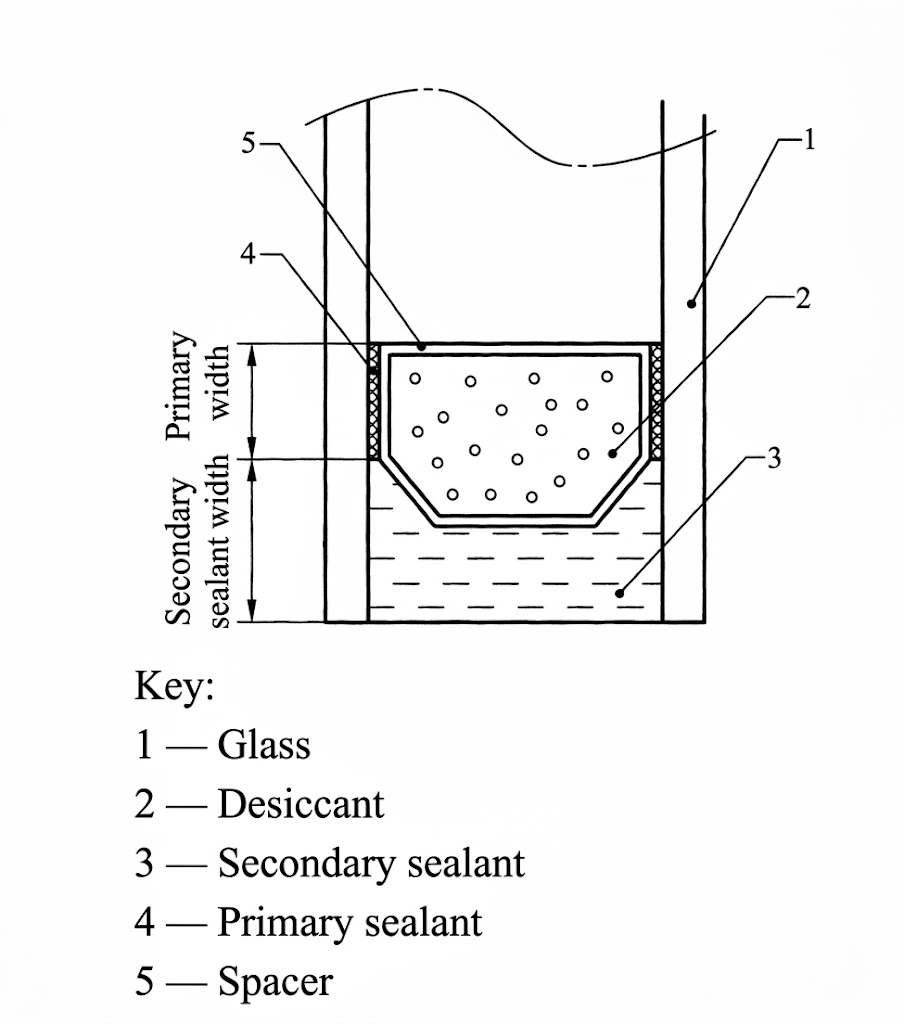
From the cross-sectional structure, a standard piece of insulating glass consists of five core components:
1. Glass: Constitutes the main light-transmitting and blocking layer.
2. Spacer (aluminum spacer): Evenly separates the two pieces of glass to form a gas layer.
3. Desiccant (molecular sieve): Absorbs residual moisture between layers to prevent condensation inside the glass.
4. Primary sealant (butyl sealant): The first seal, mainly acting as an airtight barrier to prevent external moisture from penetrating the insulating layer, is the first physical barrier to prevent condensation and failure.
5. Secondary sealant (structural sealant): Bonds the inner and outer glass and the spacer into a whole, bearing structural loads such as wind pressure and deformation resistance, and can be called the safety lifeline of insulating glass.
If this core sealing system fails, and external moisture penetrates causing the desiccant to saturate, the originally transparent glass will become a foggy “dirty face”, completely losing its energy-saving efficacy and structural safety.
1. Seal Failure Mechanism and the Key Role of Structural Silicone Sealant
The failure of the sealing system is often caused by long-term harsh external environments:
1. Temperature difference stress and wind load: Sun exposure causes thermal expansion, and night cooling causes contraction. Long-term “breathing action” and wind pressure of high-rise buildings exert great shear and tensile stress on the sealant.
2. UV and environmental aging: The alternation of ultraviolet (UV) radiation and acid rain easily accelerates the aging and embrittlement of inferior sealants.
3. Compatibility issues: Chemical conflicts occur between the sealant and surrounding contact auxiliary materials, leading to the loss of bonding force.
In coping with these challenges, structural silicone sealant plays an irreplaceable role in the secondary sealing system. The siloxane (Si-O-Si) main chain gives the insulating glass sealants extremely high bond energy, giving it natural immunity to UV rays and extreme high and low temperatures, fundamentally preventing material embrittlement. It has excellent displacement bearing capacity and long-term structural bonding force, which can not only buffer edge stress, but also safely transmit wind loads to the building frame.
2. Insulating Glass Dual Sealing Standard Process
Currently, the vast majority of insulating glass on the market uses a dual sealing process. A standardized glue injection process is the foundation for ensuring lifespan.
Primary sealing: Hot melt butyl sealant process
Butyl sealant has an extremely low water vapor transmission rate. It is the most effective barrier to block moisture between the side of the aluminum bar and the glass, and provides a foundation for the molding of the secondary sealant.
1. Incoming inspection: Check for obvious particles and debris.
2. Parameter adjustment: Adjust extrusion temperature, coating speed, and extrusion pressure according to the construction environment.
3. Coating and laminating: Exhaust the air in the cylinder to ensure the coating has no broken lines, bubbles, and impurities, and then complete the lamination positioning.
Secondary sealing: Two-component sealant injection process
The secondary sealant not only needs to bond the glass and the spacer frame into a whole, but also needs to play the role of elastic recovery and buffering edge stress. Taking two-component silicone sealant as an example:
1. Incoming inspection: Conduct butterfly test (check mixing uniformity), snap time test (evaluate mixing ratio and curing time), and peel adhesion test.
2. Mixing and injection: Strictly mix A/B components according to the ratio. Use a gluing machine to evenly inject the sealant area, completely fill both sides of the spacer frame, ensure contact with the butyl sealant and no bubbles in the middle.
3. Resting and curing: Move to a dust-free environment with 10-35°C and 35%-75% relative humidity. It can only be moved after standing for 3-5 days, and must wait for a total curing period of 14 days before wall installation.
3. Typical Defect Troubleshooting: Common Problems in the Production Process
Sealant construction involves multiple variables such as substrates, environment, equipment, and personnel. Common workshop problems are concentrated in the following three categories:
1. Particles after mixing (easy to cause gun blockage): The gluing interruption time exceeded the snap time of the day, or the cleaning was incomplete after gluing. In addition, component B is sensitive to moisture. If stored improperly, skinning on the surface is pressed into the pipeline, or the O-ring of the pressure plate is aging and loose, causing moisture to enter, particles will be generated. If the mechanical filter and one-way check valve at the equipment end are not cleaned for a long time, this fault will also be triggered.
2. Bubble problems: Small molecule gases will be released during the silicone reaction. If exposed directly to the sun after gluing, rapid skinning on the surface will cause the internal gas to be unable to release and bulge into large bubbles. Equipment reasons are mostly incomplete exhaust during barrel changes, insufficient gluing density entrapping air, or asynchronous stroke of A/B pumps (excessive pressure of pump A at the moment of starting gluing causes collapse and bubbling).
3. Unsatisfactory partial bonding of glass: Usually caused by not conducting compatibility tests, insufficient curing time, or substrate cleaning solvent not thoroughly dried. It is worth noting that the “curing” of the glue and the “establishment of adhesion” are independent. Complete curing does not mean effective adhesion has been established. Wear of the cylinder gasket at the equipment end will cause uneven mixing of the curing agent and generate “flower glue” (needs to be troubleshot through continuous extrusion testing).
4. Safety Baseline and On-site Quality Control Quick Test
In production management and on-site construction, the safety red line must be guarded, and hidden dangers must be intercepted at the front end relying on scientific quick testing methods and the latest national standards.
1. Strictly guard the material red line: Glue selection and “combustion quick test method”
In curtain wall (especially hidden frame curtain wall) applications, the use of polysulfide sealant for outer sheet lamination is strictly prohibited. Polysulfide sealant has extremely poor UV resistance, and long-term direct radiation easily causes aging and debonding. The outer sheet of the hidden frame curtain wall completely relies on the secondary structural sealant for stress. Once debonded, it will directly cause a serious safety accident of glass falling.
On-site quick test method (combustion identification method): This is the most reliable and rapid blind test method in the industry.
1. Operation: Cut a section of secondary sealant strip, ignite it with an ordinary fire source (lighter), and smell the burning odor.
2. Judgment: If there is an obvious burning smell of sulfur element (similar to the sulfur smell of burning matches), it is a polysulfide sealant; if there is no sulfur smell, it is a silicone sealant.
3. Principle: The main chain of polysulfide sealant contains a large amount of sulfur (-S-S- bonds), and burning will generate characteristic sulfur-containing oxides; while the main chain of silicone sealant is Si-O-Si siloxane, containing no sulfur, directly targeting the difference in molecular structure, making it obvious upon burning.
2. Ultimate acceptance standard: Accurate judgment of hand pull test (peel test)
The “unsatisfactory partial bonding” mentioned earlier must be finally characterized through a hand pull test in actual quality inspection.
1. Adhesive failure (Unqualified): The glue entirely falls off the glass or aluminum profile substrate. This indicates that the glue and the substrate did not bond at all (surface not cleaned, unprimed, or incompatible materials), and the whole batch must be reworked.
2. Cohesive failure accompanied by pore defects (Needs evaluation): The colloid breaks internally (glue is still attached to the substrate), but pores or broken glue are found on the fracture surface. This is a typical construction gluing defect (entrapped air), and it needs to be evaluated for repair or rework based on severity.
3. Qualified state: The colloid undergoes pure cohesive failure, and the cross-section is dense without bubbles, proving that the bonding force is already greater than the tensile strength of the colloid itself.
The excellent performance of insulating glass depends not only on the calculation of design parameters, but also on the front-line practical operations in the workshop. Deeply understanding the chemical properties of materials, choosing the correct structural sealant under a compliant framework, supplemented by strict on-site quick testing and standard glue injection processes, is the only path to give buildings a safe, energy-saving, and long-lasting “outer garment”. Follow the WEIDU LinkedIn page for more industry updates and professional solutions.
Looking for a Reliable B2B Sealant Partner?
With a strong factory R&D background and comprehensive market solutions, we are ready to serve your wholesale needs.
Contact Person
Bella
Weidu Team Leader