
B2B Guide | Quality Control & Application
The debate between MS Polymer and silicone is heating up, but which one is truly the best choice? Whether you are a project contractor or a DIY enthusiast, this blog explores the practical science behind both adhesives. Combined with industry experience from WEIDU, we guide you to choose the most suitable solution for your structural engineering needs. If you are actively comparing ms polymer vs silicone sealant, this comprehensive guide is for you.
Table of Contents
Toggle1. What is MS Polymer Sealant?
MS Polymer is a hybrid material combining the elasticity of silicone and the strong adhesion of polyurethane. Its silane terminated polymers cure upon exposure to moisture, forming a stable cross linked structure. It offers excellent adhesion to most substrates. Its elongation at break can exceed 300 percent. However, under long term repeated deformation, its elastic recovery is generally inferior to silicone.
MS sealant is solvent resistant and easy to clean. It is highly compatible with organic coatings like asphalt and neoprene. With extremely low VOC content, it releases no harmful isocyanates or solvents, making it an eco friendly material safe for both workers and the environment. Its operating temperature ranges from negative 40 degrees Celsius to 90 degrees Celsius. While it has better UV resistance than traditional polyurethane, its flexibility and strength decrease at high temperatures, and prolonged outdoor exposure can cause chalking or fading.
2. What is Silicone Sealant?
Silicone is composed of polysiloxane chains and organic groups. The high bond energy of the silicone polymer main chain makes it exceptionally stable. It maintains excellent adhesion across a temperature range of negative 50 degrees Celsius to 150 degrees Celsius. It resists UV rays and thermal degradation, preventing yellowing even under prolonged outdoor sun exposure. It is also chemically inert to water, weak acids, and alkaline materials. However, due to its low surface energy, it lacks functional groups compatible with paint, making it unsuitable for direct overpainting.
Silicone sealants are divided into acidic and neutral types, each with unique advantages despite their different curing systems. Acidic silicone cures faster and is more affordable, making it ideal for non porous materials like glass and ceramics. The acetic acid released during curing can corrode metals like copper and zinc, and some homeowners dislike the vinegar like odor. In contrast, neutral silicone has a much milder curing formula. It does not release acetic acid, offering broader compatibility with over 85 percent of substrates on the market.
3. MS Polymer vs Silicone Sealant: Which is Better?
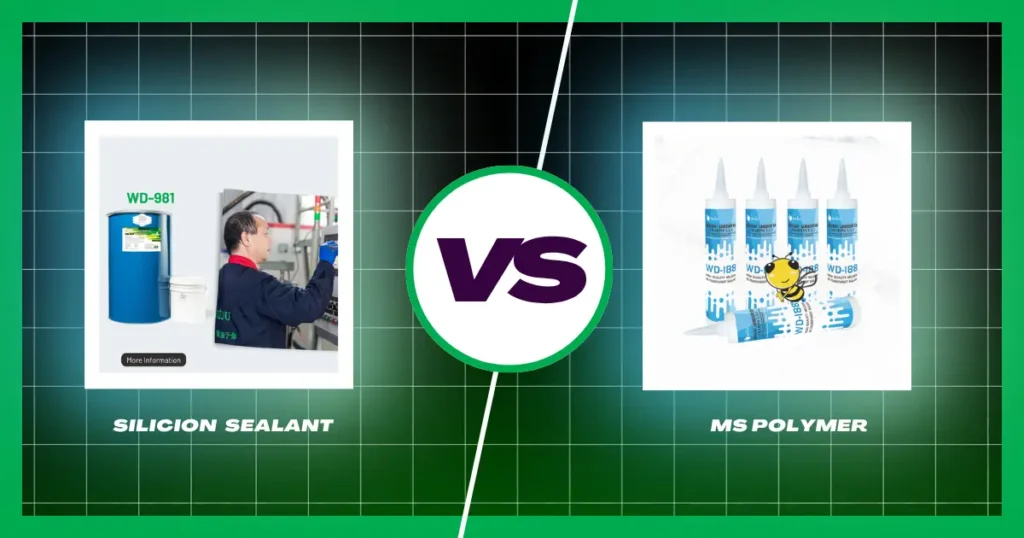
MS polymer and silicone sealants excel in different application areas, and neither is universally superior. Choose silicone for projects requiring higher flexibility and weather resistance. MS Polymer is more suitable for applications demanding strong initial adhesion and paintability.
| Feature | MS Polymer | Silicone Sealant |
|---|---|---|
| Structural Integrity | Less prone to sagging in vertical joints | Features low modulus and high deformation adaptability |
| Adhesion Strength | Strong adhesion. Effectively bonds various materials including porous and non porous surfaces without primer | Slightly lower initial adhesion strength than MS polymer but highly durable. Bonds well with most substrates like glass, metal, and ceramics |
| Flexibility | Lower elasticity than silicone | Highly flexible, able to withstand higher mechanical loads. Ideal for areas experiencing thermal expansion and contraction like windows and building facades |
| Weather Resistance | UV and weather resistance are inferior to silicone | Exceptional weather, UV, and extreme temperature resistance. Does not age under prolonged sun exposure |
| Curing Speed | Faster curing rate | Slower compared to MS Polymer. The curing process is highly influenced by humidity and temperature |
4. MS Polymer vs Silicone Sealant for Structural Engineering
In building structure projects, joint areas constantly endure thermal expansion and contraction, wind loads, and cyclic deformation. This directly relates to the mechanical properties of the sealant. A professional structural sealant is not judged by a single metric. It requires an optimal balance among all indicators. Generally, we focus on tensile strength, modulus, and elongation at break.
Tensile strength is the maximum tensile stress a sealant can withstand before breaking. Modulus is the stress generated during deformation. A higher modulus is not always better as it relates to the balance of strength and flexibility. Elongation at break indicates how far the sealant can stretch before failing. Elongation is different from elastic recovery. According to WEIDU laboratory data, certain MS construction sealants achieve an elongation at break exceeding 250 percent, but their elastic recovery rate is less than 70 percent. This indicates poor deformation resistance. For joint sealants subjected to repeated thermal or mechanical movement, elastic recovery and long term deformation resistance are critically important.
Silicone is renowned for its low modulus and outstanding flexibility, offering excellent tensile recovery. Many silicone products can stretch 300 to 500 percent of their original size and recover 80 percent of their original dimensions after minor deformation. This makes silicone the ideal choice for joints experiencing significant long term movement. Furthermore, silicone maintains a stable modulus over a wider temperature range, reducing the risk of stress transfer to the building during expansion and contraction.
The structural adhesive determines the ability of a building structure to withstand mechanical displacement and environmental erosion. Improper selection leads to cohesive failure or joint breakdown. Sealant failure is the primary cause of water leakage complaints in building structures, accounting for over 50 percent of issues. Both MS and silicone sealants are suitable for high movement gaps, but silicone can withstand greater displacement. MS sealants typically accommodate movement capabilities around 20 to 30 percent. When joint displacement is large, silicone structural sealants should be the first consideration. MS sealants are better suited for low to medium movement gaps or projects requiring paint finish.
5. Common Application Scenarios
5.1 Silicone Sealant Applications: Silicone is the mainstream choice for structural glass curtain walls, such as the WEIDU 981 series. It is commonly used for structural glazing, curtain wall structural installation, and equipment fixation requiring high displacement stability.
5.2 MS Polymer Applications: MS polymer is typically used for sealing gaps around window and door frames, pointing stone or aluminum panel curtain walls, joining precast concrete panels, sealing building movement joints, decorative edge sealing, and interior panel installation. It fits scenarios needing a balance of bonding strength and low movement.
Final Recommendation: Silicone and MS polymers each offer unique advantages for different application scenarios. MS polymer cures quickly and provides strong adhesion, making it suitable for low to medium movement gaps or paintable joints. Meanwhile, structural silicone remains the gold standard for high UV and extreme temperature environments like glass curtain walls and structural glazing. Understanding the differences helps you make an informed choice. If you are struggling to decide, contact WEIDU experts for professional guidance.
Looking for a Reliable B2B Sealant Partner?
With a strong factory R&D background and comprehensive market solutions, we are ready to serve your wholesale needs.
Contact Person
Bella
Weidu Team Leader