
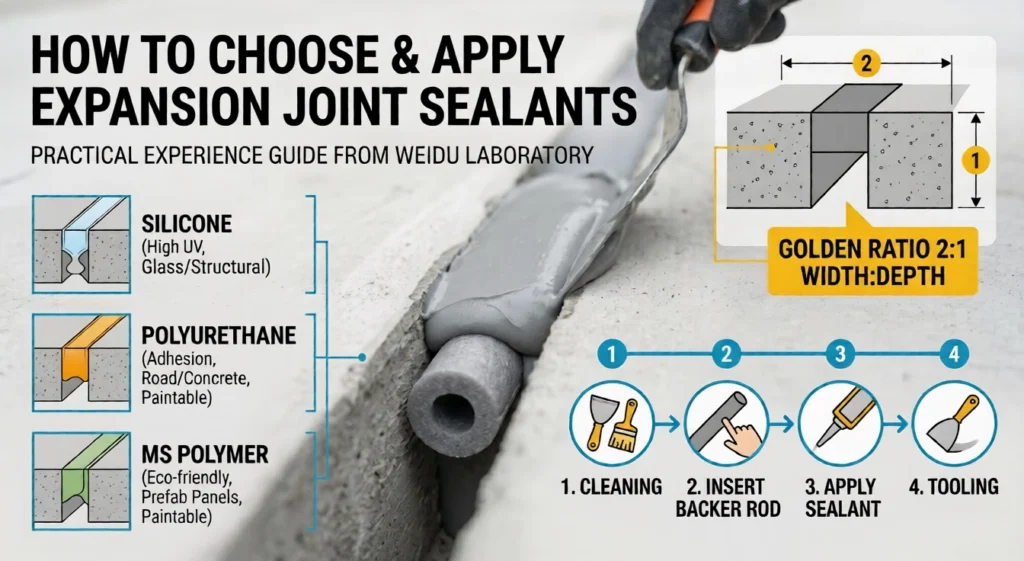
Learn the secrets to long-lasting expansion joints. Compare Silicone vs. PU vs. MS Polymer and discover the industry’s 2:1 golden ratio for application.
Table of Contents
ToggleThe Unsung Hero: Expansion Joints
Did you know? Buildings move, too. The unsung hero that enables this movement is a humble expansion joint. Building materials expand under the scorching summer sun and contract in the freezing temperatures of winter; the integrity of the expansion joint’s seal directly determines how many years a building—or a road—will endure.
I am a technical engineer at Weidu Laboratory, and I am intimately familiar with the formulations of joint sealants. When a joint fails, I know exactly which ingredients are the culprits, and I have witnessed firsthand how these materials perform across countless buildings. The content below isn’t textbook theory; it is purely a sharing of the practical experience I’ve accumulated over many years, and I hope it proves helpful to you.
Silicone, Polyurethane, or MS Polymer?
How do you choose between silicone, polyurethane, and MS polymer joint sealants? Most people assume that silicone is highly susceptible to UV damage; quite the opposite—it is actually the undisputed champion of UV resistance. For glass curtain walls, sunrooms, or any application requiring light transmission or structural bonding, silicone is an excellent choice. It can last for decades, and its elasticity is remarkably impressive. However, it has two major drawbacks: first, it cannot be painted over; and second, low-quality products can leave a greasy residue on natural stone—a phenomenon commonly referred to as “stain migration.” If your budget allows, you should definitely steer clear of inferior silicone sealants.
Polyurethane (PU) is an exceptionally robust material. It possesses strong adhesion to porous substrates and, unlike silicone, can be painted to match the surrounding floor or wall colors. It is commonly used for expansion joints in concrete structures, brick walls, parking garage floors, and even airport runways. The only downside is that prolonged exposure to sunlight accelerates polyurethane’s aging process. Furthermore, never apply it to wet concrete; PU reacts adversely to moisture by blistering—much like a skin blister—ruining the seal.
MS polymer (Modified Silane) is eco-friendly, odorless, and does not stain stone; it can also be painted. Aside from being relatively expensive, it has no significant flaws—though it must be noted that, under conditions of extreme structural deformation, its tensile strength is not quite on par with top-tier silicone sealants. It is an excellent choice for bonding prefabricated wall panels, modular housing units, and windows.
You could spend a fortune on imported products, but if the chemical materials you choose are ill-suited to your specific project—working against your engineering requirements rather than with them—they will be of absolutely no use. Every day, people ask me: “Which of these materials is the best choice?” My answer is always the same: The right choice is always the best choice.
| Feature | Silicone | Polyurethane (PU) | MS Polymer |
|---|---|---|---|
| UV Resistance | Excellent (Undisputed champion) | Poor (Accelerated aging in sunlight) | Good / Standard |
| Paintability | Cannot be painted | Can be painted | Can be painted |
| Best Applications | Glass curtain walls, sunrooms, structural bonding | Concrete, brick walls, parking floors, airport runways | Prefab wall panels, modular housing, windows |
| Key Drawbacks | Stain migration on natural stone (if low quality) | Blisters on wet concrete, ages under UV | Expensive, slightly lower tensile strength under extreme deformation |
Road Sealants: Horizontal Joints
While wall joint sealants are primarily designed to withstand wind and UV radiation, horizontal expansion joints found in pavements and airport aprons are an entirely different matter. These horizontal joints are subjected to constant rolling pressure from vehicle wheels as well as chemical erosion from oils and other contaminants—particularly in environments like parking lots and gas stations, where motor oil and diesel are ubiquitous. Standard architectural silicone sealants, if used in such settings, would soften and degrade within just a few months.
Consequently, it is imperative to use specialized oil-resistant polyurethane or high-grade silicone sealants; otherwise, the material will break down into a black, muddy sludge in less than a year. Furthermore, if road construction crews were required to squat down and manually smooth out every single strip of sealant by hand, the labor costs involved would be prohibitively expensive. To address this, road sealants are specially formulated as self-leveling liquids; once poured into the joint, the material flows automatically to form a smooth, level surface.
When selecting a road sealant, key criteria to consider include its Shore hardness and elastic recovery rate. If the sealant is too soft, small pebbles and glass shards can easily become embedded within it; then, when the concrete expands during the summer heat, these embedded fragments act like tiny nails, crushing and chipping away at the edges of the joint.
The Industry’s “Golden Ratio”
The rule is simple: the ideal ratio of joint width to depth is 2:1. For instance, if the joint is 20 mm wide, the sealant depth should be limited to 10 mm. Additionally, the joint width should ideally exceed 6 mm; if the gap is too narrow, the sealant will be unable to properly penetrate and fill the space.
You could purchase the highest-quality sealant available, but if you apply it incorrectly, the joint is liable to fail—cracking open—within just two winters. Many workers, in an effort to save time and effort, simply fill the sealant all the way to the very bottom of the joint. The result is that the sealant bonds to the bottom surface as well as the two side walls; consequently, when the concrete contracts, the sealant is subjected to extreme tensile stress and is violently torn apart. The correct procedure involves first filling the bottom of the joint with a layer of fine gravel or sand, followed by inserting a polyethylene foam rod (also known as a “backer rod”). This ensures that the sealant bonds exclusively to the two vertical side walls of the joint, allowing it to stretch and flex freely—much like a rubber band.
Installation Best Practices
When selecting a sealant, do not rely solely on advertising claims. Ask yourself: What is the specific substrate material? Will the application be indoors or outdoors? Horizontal or vertical? Will it be exposed to direct sunlight? By carefully evaluating these specific conditions, you can select the joint sealant best suited to meet your project’s unique requirements.
Whenever I receive a complaint stating that a sealant strip peeled off completely with a single tug, I ask the team to first troubleshoot their installation procedures. They must verify whether the concrete joints have been thoroughly cleared of loose dust, release agents, curing membranes, and water stains. This is particularly critical with polyurethane sealants, which are guaranteed to bubble if applied to concrete that has not fully dried.
While many MS polymer and silicone sealants claim to be “primer-free,” they absolutely will not bond securely to porous concrete or at the asphalt-concrete interface without a primer. The primer serves as a vital bonding bridge across the substrate surface. Furthermore, most sealants have specific temperature constraints for application, typically ranging from 5°C to 40°C. Attempting to apply sealant in extremely cold conditions—specifically when a thin, visible layer of frost is present—will cause the sealant to freeze immediately, rendering it completely incapable of adhering.
Expert Advice: Approaching the installation process with a “gambler’s mentality”—hoping to get lucky—is a grave mistake. Should the sealant fail, the subsequent repair work will prove far more troublesome than almost any other aspect of the project. Adhering to the “golden ratio” of a 2:1 joint profile and utilizing proper backing rods are fundamental best practices. By selecting the right sealant and executing the installation correctly, your joint will remain functional for twenty years without issue. The true value of a joint sealant is demonstrated through its long-term stability and durability—not merely by the price you paid for it at the time of purchase.