
B2B Guide | Logistics & Compliance
The shelf life of sealants is usually 12 to 18 months. Importing construction sealants to Saudi Arabia and UAE is essentially a race against time and numerous regulations. For importers, the value and risk of chemicals coexist. If there is a slight negligence in transportation, it may cause the goods to be returned by customs. Sealants are subject to strict regulatory constraints in both the UAE and Saudi markets. Many buyers only focus on the quotation, ignoring the product’s local regulatory policies and logistics services, which is the reason that causes madness during customs clearance.
Table of Contents
Toggle1. Saudi Arabia’s Compliance Access Certificate
SABER is a product conformity assessment platform launched by the Saudi Standards Metrology and Quality Organization (SASO). All goods entering Saudi Arabia must pass SABER certification. If SABER approval is not obtained, it means the product cannot enter the Saudi market, and the products in transit will face customs clearance delays, cargo rejection, fines or even restricted entry.
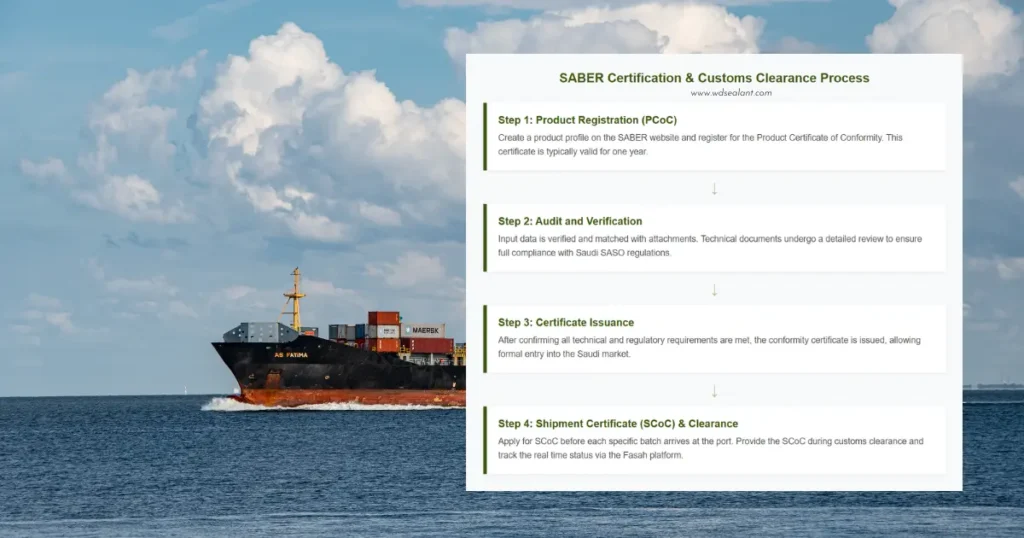
The quality and packaging of construction sealants must strictly comply with Saudi SASO’s technical regulations and complete electronic certification on the SABER platform. SABER certification steps:
SABER Certification & Customs Clearance Process
Step 1: Product Registration (PCoC)
Create a product profile on the SABER website and register for the Product Certificate of Conformity. This certificate is typically valid for one year.
Step 2: Audit and Verification
Input data is verified and matched with attachments. Technical documents undergo a detailed review to ensure full compliance with Saudi SASO regulations.
Step 3: Certificate Issuance
After confirming all technical and regulatory requirements are met, the conformity certificate is issued, allowing formal entry into the Saudi market.
Step 4: Shipment Certificate (SCoC) & Clearance
Apply for SCoC before each specific batch arrives at the port. Provide the SCoC during customs clearance and track the real time status via the Fasah platform.
1: Product registration: Enter the SABER website to create a product profile and register the Product Certificate of Conformity (PCoC)
2: Audit and verification: At this stage, the input data will be verified and matched with the attachments to ensure the accuracy of the data.
Detailed review: Carefully review technical documents and product data to ensure compliance with technical or regulatory requirements.
3: Certificate issuance: After confirming that all technical or regulatory requirements have been met, a certificate of conformity is issued, allowing formal and safe entry into the Saudi market.
4: Apply for a Shipment Certificate of Conformity (SCoC) before the goods arrive at the Saudi port
PCoC: The validity period is usually one year. Obtaining this certificate means that the building materials comply with Saudi technical regulations.
SCoC: Apply for SCoC before each batch of goods arrives at the Saudi Arabian port. SCoC must be provided when handling customs clearance. After customs declaration is completed, the real time status of the goods at customs can be tracked in the Fasah system.
2. What is the conformity certificate for building materials in the UAE?
In the UAE, all building materials that affect structural integrity, fire safety, or building performance must obtain conformity certification. The building material certification system is strict but can be predicted in advance. Understanding the regulatory policies in advance and preparing all access certificates and customs clearance documents can achieve customs clearance within 1 to 2 days without delaying for weeks. Sealants belong to regulated building materials and must pass ECAS (Emirates Conformity Assessment Scheme) certification. This certification standard is formulated by ESMA. After passing the certification, MoIAT issues the CoC certificate.
CoC: The validity period is generally 1 year, and it needs to be renewed every year.
Application process:
1. Registration: Create an account on the MoIAT e services platform
2. Document submission: Upload business license, manufacturer authorization letter, product specifications, and test reports
3. Technical assessment: MoIAT will review the documents and may request supplementary information.
4. Product testing: If necessary, please send the samples to an accredited laboratory for testing.
5. Factory assessment: Some products require production facility inspections.
6. Certificate issuance: After successful assessment, the ECAS certificate will be issued electronically.
7. Timeline: A complete application takes 3 to 6 weeks.
8. Fees: Depending on the product category and complexity, the fees range from 500 Dirhams to more than 5000 Dirhams.
To import goods into the UAE, the company must hold a valid trade license issued by the UAE Department of Economic Development (DED). The domestic company (consignee / agent) should obtain the delivery order from the freight forwarder and submit the following original standard trade documents:
1. Commercial invoice
2. Certificate of origin
3. Packing list
4. Certificate of origin
5. Bill of lading
For buyers, locking in a reliable manufacturer is very crucial. Casually changing sealant suppliers also faces many risks. Sealing materials are not like ordinary daily necessities, where you can check the quality immediately upon getting them in hand. It requires a long time of verification, especially in the Middle East desert climate region, where sealants withstand extreme high temperature climates and sand erosion all year round. Professional manufacturers never make oral promises. Technical data and test results are the golden standard for performance. You can request these documents from sealant manufacturers:
1. Technical Data Sheet (TDS)
2. Safety Data Sheet (SDS)
3. Relevant product test reports and certification certificates
4. Manufacturer detailed information and product identification
5. Batch identification and quality control records
6. Commercial invoice and packing list for shipment preparation
7. Certificate of origin and transport documents
8. Compliance documents and label information required for the destination
3. Logistics Service Efficiency
In 2026, the era of rapidly changing global logistics, manufacturers are no longer just the role of production centers. They also have sound distribution networks and flexible inventory management capabilities, which means they have complete supporting logistics services and efficiency.
Sealant packaging is generally divided into 4 types:
1. Foil sausage packaging
2. Rigid cartridge packaging
3. Metal drum
4. Plastic pail
Every packaging is meticulously designed. If you want to cut corners on packaging, the result will only be huge losses in transportation and storage. Especially in maritime container transportation, sealant packaging withstands a great challenge. Inferior packaging leaking air, squeezing and damage between pallets, will all affect the performance of the colloid or shorten the shelf life. A set of smooth logistics services includes: high quality packaging, import and export documents, access certificates, and logistics tracking services.
Why Professional Buyers Choose WEIDU
WEIDU is a native Chinese manufacturer with rich experience exporting to the UAE and Saudi Arabia. We have established our own warehouse and trading company in the UAE. By choosing WEIDU, you can get the factory price while eliminating all cumbersome import processes. You can choose to pick up the goods yourself from the WEIDU warehouse, or let us deliver them to your door within 48 hours. If you are procuring silicone sealants for curtain wall engineering, glass processing, or distribution business, please contact WEIDU to get product solutions and quotes!
Looking for a Reliable B2B Sealant Partner?
With a strong factory R&D background and comprehensive market solutions, we are ready to serve your wholesale needs.
Contact Person
Bella
Weidu Team Leader