Silicone Sealant Curing Guide: Why Rain Impacts Adhesion?
Is silicone 100% waterproof?
Silicone sealant is an elastomer with a polymer cross-linked network structure of silicon-oxygen bonds. Its molecular structure determines its natural hydrophobicity and strong water resistance; the cured colloid is not easily dissolved or destroyed by acids and bases.
So, can silicone sealant achieve 100% waterproofing? Silicone sealant can achieve 100% waterproofing in a physical sense (blocking liquid water clusters), but it is permeable at the molecular level (allowing extremely fine single molecules of water vapor to pass through). After curing, the internal network structure of the silicone sealant has certain gaps through which water vapor can slowly penetrate.
Compared to silicone sealants, polyurethane sealants and MS sealants contain hydrophilic components such as ether bonds. Long-term immersion in water can easily cause the colloid to absorb water and swell, leading to the failure of sealing performance. In insulated glass, butyl sealant, which has a lower water vapor transmission rate, is typically used in conjunction to block the penetration of water vapor. The water vapor barrier capability of butyl sealant is approximately 50 times that of silicone sealant.
What happens if silicone gets wet while drying?
The curing process of silicone sealant involves the gradual penetration of external water vapor. The cross-linking agent first undergoes a hydrolysis reaction with water to form silanols, which then undergo a condensation reaction with 107 silicone rubber to produce a spatial network structure. This process proceeds from the surface to the interior for deep curing. Under conditions of an ambient temperature of 25°C and 75% humidity, silicone sealant can achieve ideal curing speed and sealing effects.
What happens if the sealant is rained on or gets wet during the curing process? Before the colloid has finished tack-free drying, the impact of rain may change the shape of the colloid, leading to a reduction in the effective bonding area. The molecular gaps of uncured sealant are relatively large, and liquid water may seep into the interior of the uncured colloid, hindering the formation of the cross-linked structure and causing the sealing performance to fail.
If there is a certain cured thickness inside after the surface has dried, the tack-free layer can provide a physical barrier against rain. However, the bonding surface between the sealant interior and the substrate has not yet reached a state of complete attachment. Rapidly accumulating water molecules will form a water film, blocking the continuous penetration of external water vapor. This leads to insufficient moisture required for the hydrolysis reaction of the cross-linking agent, affecting the bond between the sealant and the substrate.
What is silicone sealant used for?
From the perspective of long-term stability, it is necessary to consider two aspects: the compatibility of the sealant with the substrate and the application scenario. Regarding the concept of compatibility, you can refer to the blog post How to Choose Sealant for Marble, Aluminum Panels, and Glass Curtain Walls?, which explains the principles of compatibility in detail.
The chemical composition of silicone sealant is silicone polymer, composed of silicon and oxygen atoms with a stable chemical structure. Its unique flexibility and durability allow the sealant to maintain stable performance even under harsh conditions. It can cover 70% of the substrates and application scenarios on the market: metal, wood, stone, glass, ceramics, aluminum, uPVC, concrete, etc.; it can be used in most scenarios such as kitchens, bathrooms, shower rooms, doors and windows, mirrors, architectural curtain walls, sunrooms, and skylights.
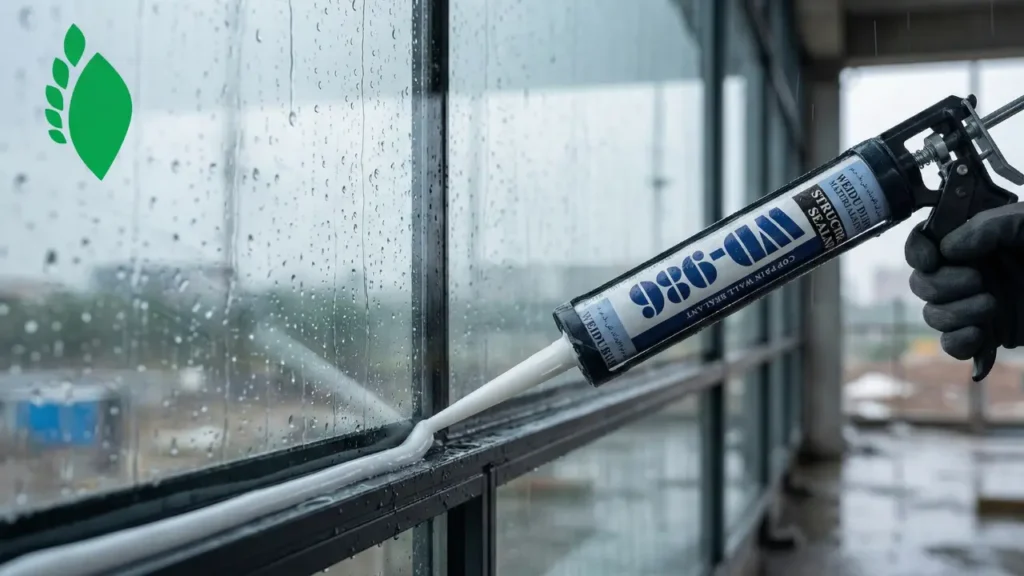
WD-866 and WD-986 neutral silicone sealants are professional-grade waterproof and weather-resistant silicone sealants, with a tack-free speed of up to 30 minutes. They are UV-resistant and aging-resistant, performing excellently even in the dry desert climates of Saudi Arabia and the UAE!
Where not to use silicone sealant?
There is an old Chinese saying: “A fine steed runs in the wilderness; a bright pearl shines in a dark room.” A good product needs to be matched with the right environment to exert its maximum effect. For professional sealant manufacturers, we care more about whether the sealant has lasting adhesion, long-term high and low-temperature resistance, UV resistance, and good compatibility with the substrate.
Ordinary weather-resistant silicone sealants are not suitable for architectural scenarios with structural stress and high elasticity requirements, such as glass curtain walls or stone/metal panel curtain walls. Choosing professional-grade curtain wall structural adhesive WD-986 or two-component silicone structural adhesive WD-981 is necessary, as their superior tensile performance and bonding strength can handle high-strength structural bonding.