
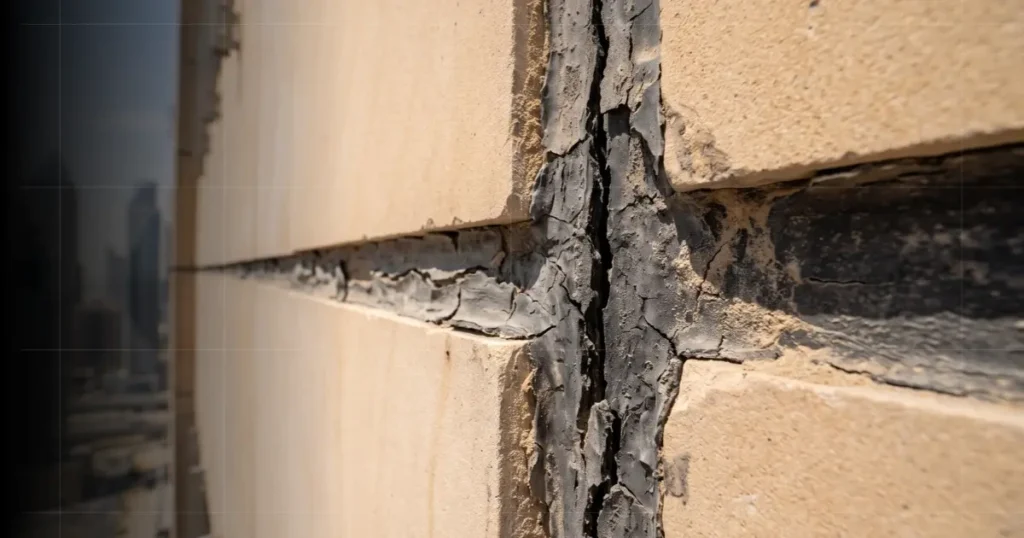
B2B Guide | Facade Troubleshooting & Thermal Expansion
In curtain wall and facade engineering, weatherproofing silicone sealant is often treated as a minor accessory from a budget perspective. Yet its role is anything but minor. Once facade joints crack due to weatherproofing sealant failure, it triggers a chain reaction of water ingress, air leakage, compromised HVAC efficiency, and even interior wall mold—turning a small material oversight into a costly, complex remedial nightmare.
Nowhere is this challenge more unforgiving than in the UAE. With ambient summer temperatures exceeding 50°C, dark aluminum and glass facade surfaces regularly reaching 70°C to 85°C, and sharp diurnal temperature swings creating relentless thermal expansion and contraction cycles, facade joints are pushed to their absolute mechanical limits. To keep a curtain wall watertight over the long term, engineers and contractors must first understand how and why sealants fail under thermal stress, and then enforce strict control across three core pillars: design, material selection, and application.
Table of Contents
Toggle1. The Three Primary Modes of Silicone Sealant Failure
When cured silicone sealant in a facade joint cracks, the failure generally manifests in one of three forms:
1. Cohesive Failure: Cracking occurs down the center of the sealant bead itself.
2. Adhesive Failure: Cracking or peeling occurs along the sides of the joint, where the sealant detaches from the substrate.
3. Mixed Failure: Both center cracking (cohesive) and edge debonding (adhesive) occur simultaneously.
2. Root Cause Analysis: Why Facade Joints Crack Under Thermal Stress
Understanding the failure mode is the first step in troubleshooting. Below is a breakdown of the underlying causes behind cohesive and adhesive failures, particularly when amplified by the UAE’s harsh climatic conditions.
Cohesive Failure (Center Cracking)
Cohesive failure typically appears as a split down the middle of the cured sealant bead, because the center is usually the thinnest cross-section and the first point to tear under tensile stress.
Sealant Quality Issues
1. Oil-Extended Silicone Sealants (Plasticizer Migration): In substandard oil-extended silicone sealants, mineral oil or hydrocarbon plasticizers continuously bleed out over time—a process drastically accelerated by the UAE’s intense heat and UV exposure. This causes the sealant to shrink excessively, harden, and lose its movement capability, leaving it unable to accommodate the thermal expansion and contraction of facade panels.
2. Formulation Defects: Insufficient cross-linker content in the formula prevents the sealant from forming a complete, robust cross-linked network structure, leaving internal structural weaknesses prone to tearing.
3. Expired Product: Using sealant past its shelf life—or sealant degraded by improper storage in uncooled UAE site warehouses—severely compromises its curing and elastic properties.
Design & Application Issues
1. Improper Joint Design: Joint widths narrower than 6mm do not provide enough sealant volume to absorb thermal movement, leading to rapid tearing.
2. Air Entrapment & Uneven Tooling: Trapping air bubbles during gunning or applying the sealant with uneven thickness creates weak points where cracks initiate first.
3. Extreme Substrate Temperatures: Applying sealant when the substrate is too hot (common on sun-exposed UAE facades during midday) or too cold induces high internal stress as the sealant cures.
4. External Forces & Severe Deformation: Subjecting the sealant to movement during its curing phase, or exposing the cured joint to extreme external loads—such as high-rise wind gusts, sandstorms, or seismic activity—can push the substrate beyond the sealant’s elongation limit.
5. Three-Sided Adhesion: When sealant bonds to the back of the joint in addition to both sides, its effective movement capability is restricted to within ±15% of its original design rating. Under normal UAE thermal cycling, a three-sided joint will almost certainly tear.
Product Suitability Issues
1. The selected sealant’s movement capability is insufficient for the actual thermal expansion delta of the joint.
2. The sealant’s modulus does not match the joint’s structural and movement requirements.
Adhesive Failure (Edge Peeling & Debonding)
Adhesive failure occurs when the bond between the sealant and the substrate breaks down, resulting in clean peeling along the joint interface and immediate loss of waterproofing.
Application & Environmental Issues
1. Improper Surface Preparation: Using incorrect cleaning methods or incompatible solvents, failing to remove fine desert dust, coastal salt deposits, or oils to the required standard, or gunning sealant before the cleaning solvent has fully evaporated.
2. Improper Primer Use: Using the wrong primer for the substrate, applying expired primer, over-applying primer, or failing to let the primer flash off and dry completely before sealant application.
3. Insufficient Compaction: Failing to tool and press the sealant firmly into the joint, leaving poor wet-out and weak contact with the substrate walls.
4. Insufficient Contact Area: Poor joint geometry that leaves too little surface area for the sealant to grip the substrate reliably.
5. Disturbance During Curing: Continuous joint movement during the curing window caused by wind loads or rapid day-to-night thermal expansion and contraction of aluminum frames.
6. Condensation & Dew Point Issues: Applying sealant when ambient temperatures drop below 5°C—or during high-humidity coastal mornings in Dubai and Abu Dhabi—can cause visible dew or invisible micro-condensation on the substrate, forming a moisture barrier that prevents adhesion.
Material Compatibility & Suitability Issues
1. Lack of Stone Staining Tests: On stone facades, skipping staining tests leaves a risk of plasticizer bleed contaminating the stone pores and weakening the bond interface.
2. Misuse of Acidic (Acetoxy) Sealants: Using acetoxy silicone on metal or stone facades triggers chemical reactions with the substrate. In glass curtain walls, using acidic sealant to bond glass to aluminum profiles or on the coated side of coated glass will directly cause adhesion failure.
3. Missing Compatibility & Adhesion Tests: Proceeding without pre-construction compatibility and adhesion testing leaves the project vulnerable to chemical incompatibility. Contact with incompatible glazing accessories—such as gaskets, spacer tapes, backer rods, or setting blocks—can cause sealant discoloration or complete loss of adhesion to the substrate.
3. Three Core Pillars to Prevent Facade Joint Cracking in the UAE
Once the root causes are clear, prevention becomes a disciplined engineering process. To stop facade joints from cracking under thermal expansion, project teams must get three things right: Design, Material Selection, and Application.
1. Engineering & Design: Controlling Width, Depth, and Movement
Joint design encompasses joint width, joint depth, and matching the sealant’s movement capability to the expected thermal movement.
Joint Width & Movement Capability Matching
Beyond aesthetics and preventing hard contact between cladding panels, the primary goal of joint width design is ensuring the joint’s movement ratio matches the sealant’s movement capability. Movement capability—the most critical technical metric for weatherproofing sealants—is graded by percentage, such as Class 25, 35, 50, or +100/-50 (for example, Class 25 means the sealant can withstand joint width fluctuations of ±25%).
1. Calculation & Minimum Width: If thermal expansion produces a high movement percentage that exceeds the sealant’s rating, cracking is inevitable. Joint widths should be calculated using established engineering formulas (such as those recommended in ASTM C1472 or JGJ 102 Technical Code for Glass Curtain Wall Engineering, Section 4.3.9). As a strict baseline, weatherproofing joint width must not be less than 6mm.
2. Beware the “Narrow Joint” Trap: On active construction sites, fabrication tolerances or installation deviations frequently result in localized joints that are narrower than the design drawings. These narrow joints are the #1 hotspot for leaks: the absolute thermal expansion of the panel remains unchanged, but because the joint is narrower, the percentage of movement spikes—exceeding the capacity of the specified sealant.
3. Specify Higher Movement Capability for the UAE: Whenever budgets allow, specifying a higher movement class (e.g., Class 50 or +100/-50) is one of the highest-ROI decisions in UAE facade design. Because the sealant operates well below its elastic limit even during peak August heat, the risk of leakage drops sharply and service life is significantly extended. The upfront material cost increase is a tiny fraction of the overall facade budget, yet it saves massive long-term high-rise maintenance expenses.
Joint Depth Control
Sealant aging progresses from the exposed surface inward—a process accelerated by high UV radiation. If a joint is too shallow, surface micro-cracks will quickly propagate through the entire bead and cause leaks. Follow these depth guidelines:
| Substrate Type / Rule | Joint Width | Required Sealant Depth |
|---|---|---|
| General Baseline | All Weatherproofing Joints | Depth must be greater than 6mm and must never exceed the joint width. |
| Porous Substrates (Concrete, Masonry, Stone) | Under 13mm | Depth should equal the width. |
| Porous Substrates (Concrete, Masonry, Stone) | 13mm – 25mm | Depth should be half the width. |
| Non-Porous Substrates (Metal, Glass) | 6.0mm – 13.0mm | Depth should be at least 6.0mm. |
| Non-Porous Substrates (Metal, Glass) | Greater than 13.0mm | Depth should be maintained between 6.0mm and 13.0mm. |
2. Material Selection: Guarding Performance and Avoiding Oil-Extended Silicone Sealants
With a sound joint design in place, material procurement must focus on three checkpoints:
1. Verify Rated Performance & Chemistry: Check product packaging and technical data sheets to confirm that movement capability and modulus meet design specs. Always specify neutral-cure silicone for metal, stone, aluminum, and coated glass—never acetoxy.
2. Guard Against Substandard & Oil-Extended Silicone Sealants: Verify that all batches are within shelf life and confirm that the sealant actually delivers its claimed movement capability via third-party laboratory testing. Be especially wary of abnormally low-priced products; screen them carefully to ensure they are not oil-extended silicone sealants, which will rapidly shrink and crack in the UAE climate.
3. Use Dedicated Stone Sealants: For natural stone facades, strictly specify dedicated non-staining stone sealants or anti-pollution weatherproofing sealants, backed by pre-project staining tests.
3. Application & Quality Control: Turning a “Semi-Finished Product” into a Waterproof Barrier
In construction, silicone sealant in a cartridge or sausage is essentially a semi-finished product. It only becomes a functional waterproofing barrier when skilled site application places it in the right location, forms the correct width and depth, achieves full cure, and establishes a reliable bond to the substrate. Site workmanship directly determines whether a facade stays watertight.
1. Mandatory Pre-Construction Testing: Before full-scale installation begins, conduct adhesion and compatibility tests using the actual project substrates and glazing accessories to guarantee long-term bond integrity.
2. Strict Site & Environmental Controls: Enforce rigorous surface cleaning (such as the two-cloth method) to remove UAE desert dust and coastal salts, and verify complete solvent/primer evaporation. Schedule gunning to avoid blistering midday substrate temperatures as well as early-morning condensation or dew. Install appropriate backer rods to eliminate three-sided adhesion, tool the sealant firmly to compact it without air bubbles, and minimize external disturbances during curing.
3. Ongoing Field Quality Control: Implement routine on-site QA/QC checks, including periodic field hand-pull (pull-tab) adhesion tests on cured sealant joints, to directly inspect bead appearance, cure consistency, and bond strength—catching and correcting issues before handover.
Key Engineering Takeaway: Preventing facade sealant cracking in the UAE’s extreme thermal environment is a tightly linked system. By diagnosing the exact mechanics of cohesive and adhesive failure—and backing that knowledge with disciplined joint design, verified materials, and rigorous site quality control—that seemingly small line of sealant becomes a durable, long-term shield against the elements. Need substrate compatibility testing or high-movement facade solutions? Contact WEIDU for technical consultation, or follow WEIDU LinkedIn for ongoing facade engineering insights.
Frequently Asked Questions: Facade Joint Cracking in the UAE
Why do facade joints crack so easily in the UAE climate?
In the UAE, ambient summer temperatures exceed 50°C while dark aluminum and glass facade surfaces regularly reach 70°C to 85°C. Combined with sharp day-to-night temperature swings, these extreme conditions create relentless thermal expansion and contraction cycles that push under-designed or low-grade sealants past their elastic limits.
What is the difference between cohesive failure and adhesive failure?
Cohesive failure occurs when cracking runs down the center of the sealant bead itself—typically caused by oil-extended formulas, three-sided adhesion, narrow joints, or insufficient movement capability. Adhesive failure occurs when the sealant peels cleanly off the substrate edges due to poor surface preparation, condensation, misuse of acidic sealant, or incompatible glazing accessories.
Why should oil-extended silicone sealants be avoided in UAE facade projects?
In oil-extended silicone sealants, mineral oil or hydrocarbon plasticizers continuously bleed out over time—a process drastically accelerated by intense UAE heat and UV radiation. This migration causes excessive shrinkage, hardening, and a severe loss of movement capability, leading to rapid cracking.
What is three-sided adhesion and how does it cause joint tearing?
Three-sided adhesion happens when the sealant bonds to the back of the joint in addition to both side walls. This restricts the sealant’s effective movement capability to within ±15% of its original design rating, almost guaranteeing tearing under normal UAE thermal cycling. Installing an appropriate backer rod eliminates three-sided adhesion.
What are the minimum width and depth standards for facade weatherproofing joints?
As a strict baseline, weatherproofing joint width must not be less than 6mm, and sealant depth must be greater than 6mm without ever exceeding the joint width. For non-porous substrates like metal and glass, depth should be at least 6.0mm for 6.0–13.0mm joints and maintained between 6.0mm and 13.0mm for wider joints.
Why is neutral-cure silicone mandatory for aluminum, stone, and coated glass?
Acidic (acetoxy) silicone triggers chemical reactions with metal, stone, and glass coatings, directly causing adhesion failure. Always specify neutral-cure silicone for these substrates, and use dedicated non-staining stone sealants backed by pre-project staining tests for natural stone facades.
Looking for a Reliable B2B Sealant Partner?
With a strong factory R&D background and comprehensive market solutions, we are ready to serve your wholesale needs.
Contact Person
Bella
Weidu Team Leader