
B2B Guide | Quality Control & Testing
As the secondary seal of insulating glass units, the adhesion of silicone sealant plays a decisive role in the curtain wall system, affecting the life cycle of the entire curtain wall system. The wind pressure and vibration borne by the glass panels are all transmitted through the structural silicone sealant. When the bonding function of the curtain wall system has problems, it will bring moisture infiltration and debonding to the insulating glass unit, and even trigger safety issues. Peel adhesion testing can quickly detect whether the bonding between the sealant and the substrate is effective. This guide will introduce the steps of peel adhesion testing in detail and explore troubleshooting solutions for curtain wall sealant failures.
Table of Contents
Toggle1. What is Sealant Peel Adhesion Testing?
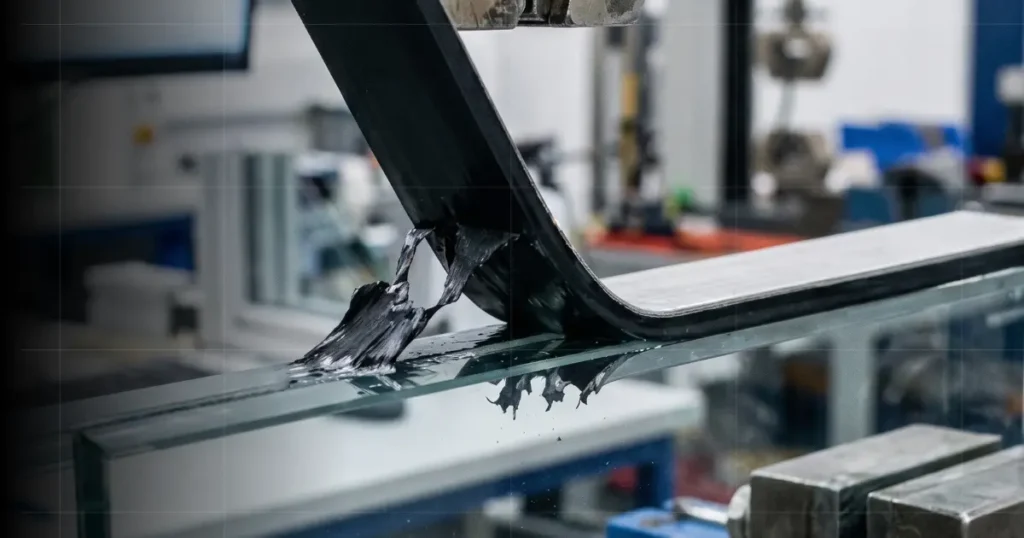
ASTM C794 provides a standardized laboratory method. This test requires embedding a flexible wire screen between two layers of sealant. After waiting for the sealant to cure, a tensile testing machine is used to pull the wire screen backward at a 180° angle. Through the peel force and failure mode, the bonding characteristics between the sealant and the substrate are evaluated, and its test results directly reflect whether the bonding between the sealant and the substrate is effective. A high peel force does not mean that the overall performance of the sealant is superior. During evaluation, it must also be combined with the failure mode, substrate characteristics, flexibility of the sealant, and the intended application scenario.
The peel test is an important test prior to mechanical property testing. If specific mechanical property parameters are required, it will move on to dumbbell-shaped specimens and H-type specimens. Dumbbell specimens mainly detect tensile strength and elongation; H-type specimens include three elements: interface failure, tensile strength, and elongation. Unlike H-type specimens, which require curing the sealant for 28 days before entering testing, the peel test requires a much shorter curing cycle for the sealant.
2. How to Determine Peel Adhesion Testing Results
During the process of peeling the sealant from the substrate surface, the colloid fractures due to external stretching. In actual construction, if the colloid is unevenly mixed, contains air inside, or has large particles in the colloid, these are all reasons that easily cause the sealant to fracture. During the experiment, we use an external force exceeding the maximum tensile strength of the sealant to create a fracture point inside the colloid, and observe the failure mode of the fracture point to preliminarily draw a conclusion on sealant adhesion. The experimental results include two failure modes:
1. Cohesive Failure
When the fracture point occurs inside the colloid and the sealant tears due to its own stress concentration, we call it cohesive failure. That is to say, the sealant does not fall off from the substrate surface, but is torn inside the colloid. From the experimental results, it can be observed that part of the colloid still adheres firmly to the substrate, which is a good experimental result.
In the WEIDU laboratory, lab technicians observe the percentage of colloid residue on the substrate surface according to the tearing condition of the colloid. For example, 95% residue has better interfacial adhesion than 5% residue. This distinction helps to compare the experimental results of cohesive failure.
2. Adhesive Failure
Adhesive failure is also called interfacial debonding. During the peeling and stretching process of the sealant, the fracture point occurs on the bonding surface with the substrate, and the bonding surface separates directly from the substrate interface. The experimental results show that the sealant peels off very cleanly from the glass surface, with very little or almost no residue. When the tensile bearing capacity of the sealant is more concentrated, it indicates that its flexibility is good, but the adhesion force with the interface is insufficient, which will lead to interfacial debonding. In this case, we directly judge it as adhesion failure, which is the worst result for adhesion. WEIDU lab technicians will focus on analyzing the causes of debonding, as formulation, substrate, curing state, etc., can all lead to debonding.
ASTM C794 clearly states:
“This test requires that the results indicate whether the failure mode is primarily adhesive or cohesive. It is important to note that a cohesive failure is not necessarily better than an adhesive failure, if the adhesive value is sufficient for the application. Having adhesive failure allows one to study the change of adhesion with time and with the various stress conditions.”
Source: ASTM C794 Standard Test Method
3. Troubleshooting Curtain Wall Adhesion Failures Through Peel Testing
Curtain wall systems withstand stresses caused by ambient temperature fluctuations, UV radiation, wind pressure, and building movements all year round. Through the principle of the peel test, engineers can be assisted in evaluating the bonding condition between the curtain wall silicone sealant and the substrate on-site. When curtain wall glass debonds, engineers inspecting the separated joints can reach a preliminary conclusion: for example, in some cases, the sealant still adheres to the bright surface of the substrate, but tearing occurs inside the colloid. This may indicate that the bonding interface remains intact, while the sealant body withstood excessive stress leading to cohesive failure. If the inspection finds almost no sealant residue on the glass surface at the joint, this situation is the adhesive failure we mentioned, and there may be problems with sealant quality or construction procedures. The preliminary conclusion drawn on-site will help troubleshoot the root cause of curtain wall glass debonding. Whether it is cohesive failure or adhesive failure, it will be combined with subsequent further mechanical property testing and analysis.
4. Guardian Glass Sealant Adhesion Testing Standards
For the secondary sealant of insulating glass, adhesion performance is crucial. However, the sealant needs to work together with glass coatings and other components of the insulating glass. Therefore, one cannot only focus on whether it can stick to ordinary glass, but also needs to pay attention to the compatibility between the sealant chemical system and specific Low-E coatings. According to Guardian Glass technical guidelines, certain chemicals used in sealant formulations may affect the metal layer of Low-E coatings, so rigorous evaluation must be conducted on the compatibility between the sealant and specific coated glass systems. Guardian Glass provides professional industry evaluation requirements for sealants and specific glass products. The professional value of Guardian lies in its ability to evaluate from the perspective of a glass manufacturer whether a sealant is suitable for use in combination with specific glass products, especially Low-E glass.
WD-881 is listed on the Guardian Glass compatibility list for specific SunGuard and ClimaGuard products. The compatible products on the list do not require edge deletion in ordinary glazing applications, but the exposed edges of Step Glazing still have edge deletion requirements. For insulating glass processing factories using Guardian Low-E glass, this is a valuable reference basis when procuring sealants.
There is no shortage of low-priced sealants on the market, but raw materials vary. Some low-priced products can also achieve relatively good adhesion—for example, by increasing the dosage during construction, using a thick-coating method to achieve the bonding effect. Meanwhile, a high-quality sealant can save half the dosage to achieve the exact same effect, or even better. Therefore, comparing the purchase price makes it look like a saving, but in reality it increases overall material consumption. This is a good thing for sellers because their products are consumed faster and the customer reorder rate is high, but this is not the practice advocated by WEIDU. WEIDU has persevered in the sealant field for 20 years, and our products insist on speaking with data. Welcome to contact WEIDU to discuss your project requirements with us.
Looking for a Reliable B2B Sealant Partner?
With a strong factory R&D background and comprehensive market solutions, we are ready to serve your wholesale needs.
Contact Person
Bella
Weidu Team Leader
Frequently Asked Questions on Peel Adhesion Testing
What is a sealant peel adhesion test?
ASTM C794 provides a standardized laboratory method. This test requires embedding a flexible wire screen between two layers of sealant. After waiting for the sealant to cure, a tensile testing machine is used to pull the wire screen backward at a 180° angle. Through the peel force and failure mode, the bonding characteristics between the sealant and the substrate are evaluated.
Does a high peel force mean the sealant has better overall performance?
No, a high peel force does not mean that the overall performance of the sealant is superior. During evaluation, it must also be combined with the failure mode, substrate characteristics, flexibility of the sealant, and the intended application scenario.
What does “Cohesive Failure” indicate in a peel test?
When the fracture point occurs inside the colloid and the sealant tears due to its own stress concentration, we call it cohesive failure. The sealant does not fall off from the substrate surface, but is torn inside the colloid. Part of the colloid still adheres firmly to the substrate, which is considered a good experimental result.
What does “Adhesive Failure” indicate in a peel test?
Adhesive failure is interfacial debonding. During the peeling and stretching process, the fracture point occurs on the bonding surface with the substrate, and the bonding surface separates directly from the substrate interface. The sealant peels off very cleanly from the glass surface, with very little or almost no residue. This is directly judged as adhesion failure.
What is the difference between peel testing and mechanical property testing?
The peel test is an important test prior to mechanical property testing. It evaluates adhesion and requires a much shorter curing cycle. If specific mechanical property parameters are required (such as precise tensile strength and elongation), testing will move on to dumbbell-shaped specimens and H-type specimens (which require a 28-day curing period).